Left Column Top
Left Column Bottom
Right Column
Coast 4U Quarterly, Winter 2014
Japan Tsunami Debris Cleanups
Since the beginning of 2013, volunteers up and down the California coast have been scouring
beaches in search of a very particular kind of debris: items that may have originated in Japan
as a result of the massive tsunami that devastated the country in March of 2011. Thanks to a
generous grant from the California Office of Emergency Services (CalOES) and the National Oceanic
and Atmospheric Administration (NOAA), almost 5,000 volunteers turned out to close to 60 cleanups
scattered within the 15 coastal counties. These volunteers, armed with a new data card that the
Coastal Commission developed, sought out items that had been previously identified as "potential"
tsunami debris. Items such as plastic bottles with Japanese writing on them, buoys, large Styrofoam
pieces, and building materials like lumber could potentially indicate locations where tsunami
debris was washing up. The goal of this effort was to gather debris and data that could help us
better determine the scope of the problem, the likely location of larger accumulations of debris,
and the need, if any, for assistance from local emergency responders.
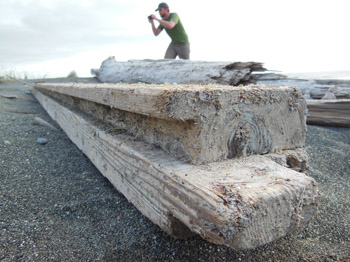
Since late 2011, large items from the tsunami have been washing up across the West Coast. A large "ghost" fishing vessel off British Columbia in November 2011; a massive 100-ton, 66-foot long pier in Newport, Oregon in early 2012; enormous accumulations of Styrofoam along islands in the Gulf of Alaska since the beginning of 2012; another pier on the Olympic Coast of Washington in late 2012; the list was growing, and it was growing earlier than researchers had anticipated it would. But California seemed largely immune to this new problem that was affecting almost every other spot along the West Coast of the US and Canada. It seemed strange, to say the least, that tsunami debris would somehow stop floating on the ocean currents once it reached the Oregon-California border. And anecdotal reports from locations along the California coast indicated that unusual items were indeed beginning to wash up. But without positive identifying markers, like ownership or origination information on any of the suspect items, it was impossible to determine if those items were definitely the result of the tsunami. Without definitive identifying information, the next best option is to establish a baseline of data on potential tsunami debris and then look at trends over time. That's where the power of the beach cleanup volunteers came into play. Adopt-A-Beach volunteers are out at sections of the California coast just about every weekend of the year. Recognizing that we could harness that power to help us gather better information, the Coastal Commission worked with several organizing groups to establish a calendar of events designed to gather data about the suspected tsunami debris. After almost 60 cleanups, we now have a baseline of information available to us showing that there have, in fact, been a number of items collected that could be tsunami debris. Much of it was gathered in the northern part of the state, but suspicious items have been found as far south as San Diego County; no county was entirely free from items that could have originated from the tsunami.
Does this mean that California is seeing an increase in debris along our coast because of the tsunami? Not necessarily. In fact, items from around the Pacific Rim wash up on California's shores every single year. Until now, we've never had a way to measure their quantity or their impact. With a baseline in hand, we now have a way to measure this source of debris going forward. With the continued help of our partnering organizations and volunteers like you, we will be able to keep collecting this data over the next two years to more accurately compare what we're seeing and where it is washing up. Is it safe?These are questions we've been asked many times over the past year of tsunami debris cleanups: is the debris safe? Is the water safe? Is there any radioactivity to be worried about?Since the start of this effort we have been concerned about potential harmful impacts to our volunteers and our environment from effects of the tsunami, whether it's increased radioactivity or hazardous debris washing up. Before beginning the cleanup program, we carefully reviewed the available data on risk analyses and testing done on previously identified tsunami debris, which indicated no elevated levels of radiation. In addition, we've worked with the EPA, the Office of Emergency Services, and local Public Health agencies to make sure that testing for radioactivity is undertaken on an ongoing basis and that emergency responders are always ready to help in case hazardous materials are found. The good news is that there has not been a single test or find anywhere along the West Coast that indicates any danger from nuclear radioactivity. The radiation from the Fukushima nuclear plant, including the water that has been and is still being released from that plant, dissipates in concentration very quickly, and it is not detectable off the coast of California. All of the debris that has been traced back to the tsunami has been tested as well, and none of the debris has been shown to have elevated levels of nuclear radioactivity. So while there have been numerous misleading reports in various media outlets over the past months about radioactivity scares, the California Department of Public Health recently issued a statement that says: There is no public health risk at California beaches due to radioactivity related to events at Fukushima. The California Department of Public Health (CDPH) is not aware of any recent activity at Fukushima, or any new data that would cause elevated radioactivity on California shores from the Fukushima incident... The volume of water in the Pacific Ocean has a significant diluting effect on radionuclides that are present and it is not anticipated that the concentration will increase in the waters off of the west coast. This is all good news for our volunteers, our coast, and all the wildlife who call it their home. Local, State, and Federal staff will continue to test and monitor the coast for signs of any increase in danger. For now, however, the Coastal Commission looks forward to another year of incredible volunteer cleanups as we continue to search for, record, monitor, and clean up debris along our coast, for all our benefit. More Resources:
|