Left Column Top
Left Column Bottom
Right Column
Coast 4U Quarterly, Spring 2013
First confirmed piece of tsunami debris hits California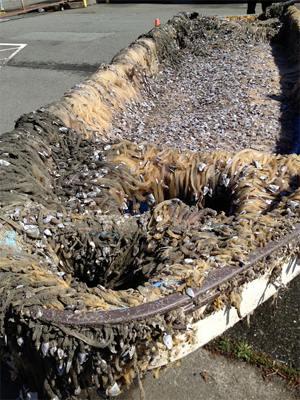 Crescent City,
one of the last cities found along the beautiful northern California coast before you reach Oregon and home to the
famous Battery Point Lighthouse, now has another claim to fame. On April 7th, the first confirmed piece of debris
from the Japan Tsunami to hit California washed up on the shores of a local beach. The 20-foot boat that was
found was traced back to Takata High School in Japan's Iwata Province, an area that was devastated by the March,
2011 earthquake and tsunami. California now joins its west coast neighbors Alaska, Washington, Oregon, Hawaii,
and British Columbia in the list of areas where tsunami debris has been confirmed by the National Oceanic and
Atmospheric Administration (NOAA) and the Japanese Government.
Crescent City,
one of the last cities found along the beautiful northern California coast before you reach Oregon and home to the
famous Battery Point Lighthouse, now has another claim to fame. On April 7th, the first confirmed piece of debris
from the Japan Tsunami to hit California washed up on the shores of a local beach. The 20-foot boat that was
found was traced back to Takata High School in Japan's Iwata Province, an area that was devastated by the March,
2011 earthquake and tsunami. California now joins its west coast neighbors Alaska, Washington, Oregon, Hawaii,
and British Columbia in the list of areas where tsunami debris has been confirmed by the National Oceanic and
Atmospheric Administration (NOAA) and the Japanese Government.
The boat in Crescent City was typical of much of the confirmed tsunami debris that has arrived so far. It was covered with Gooseneck Barnacles, a common and widespread filter feeder that attaches itself to floating objects in the open ocean. The barnacles illustrate an important emerging issue for marine debris—the prospect that floating debris could transport invasive species. While gooseneck barnacles are not invasive, other species that could be carried by the tsunami debris may be. In fact, the pier that washed up in Oregon in 2012 carried almost a hundred different near-shore species, some of which were on Oregon's "Most Watched" list for highly invasive species. While the Crescent City boat is the first item officially confirmed by the U.S. and Japanese governments as tsunami debris in California, Coastal Commission volunteers have been conducting cleanups aimed at identifying potential tsunami debris along the coast since the beginning of this year. They have made a number of discoveries that raise the possibility California has been experiencing the impact of tsunami debris for some time. Volunteers in Humboldt, Del Norte, and Mendocino counties have found various items, like milk crates, bottles, and plastic pieces, with Japanese writing on them. Even in areas as far south as San Diego, volunteers report finding unusually large amounts of Styrofoam pieces on a beach where Styrofoam is rarely found.
As we work to clean our beaches and gather as much information as possible about what washes onto our shores from the ocean, it is important for all of us to be mindful that the origin of the tsunami debris was a horrific human tragedy. Takata High School has requested that their boat be returned to them, and California and NOAA are working together to make this happen. It may seem a small gesture, but whatever we can do to return identified items to their owners—to bring even a small measure of relief—should be done. The fact that the ocean connects everyone throughout the Pacific Rim has been made all the more apparent by this tragedy. We all share one ocean, and we must work together to take care of this precious resource. |